


Agentic Native#
The actor mesh is the most general agentic pattern: each AI agent runs as an independent actor with its own scaling, failure isolation, and queue. Agent swarms become distributed systems with all the operational properties of the mesh.
Agents as actors#
Each agent in an Asya mesh is a standard actor — a stateless pod with a handler function. The agent's LLM calls, tool use, and decision-making live in the handler. The mesh provides everything else: message delivery, retries, scaling, and observability.
This means agent swarms get the same operational properties as any other actor pipeline:
- Independent scaling per agent (GPU agents scale differently from routing agents)
- Failure isolation — one agent crashing does not affect others
- Durable message delivery — no lost work on pod eviction
Real-time streaming with FLY events#
Actors can stream intermediate results to connected clients via FLY events:
def handler(payload: dict):
    for chunk in llm.stream(payload["prompt"]):
        yield "FLY", {"chunk": chunk}  # partial update, flies via HTTP directly to Gateway
    yield {"response": llm.result()}   # regular response to the next actor
FLY events are ephemeral — they reach only currently connected SSE clients. For
data that must survive across pipeline stages, use payload instead.
Pause and resume for human-in-the-loop#
An agent can pause execution and wait for human input:
- The agent routes to
x-pause, which checkpoints the full envelope to S3 - The gateway reports
input_requiredto the client - The human provides input via the API
x-resumerestores the envelope, merges the new input, and re-injects into the mesh
The pipeline continues from exactly where it stopped. No state is lost.
Virtual memory for agents#
Agents that need persistent memory (conversation history, tool results) use the
state proxy. The agent reads and writes files under
/state/ — the proxy persists them to S3, Redis, or another backend. The agent
remains a stateless Deployment.
Interoperability#
The HTTP Gateway exposes agents via standard A2A and MCP protocols. Your agents run as actors on the mesh — each with independent scaling, fault isolation, and queue-based communication. External AI agents and LLM clients (Claude, GPT) interact with the mesh through these standard protocols, rather than through framework-specific integrations.
Example: evaluator-optimizer loop#
A classic agentic pattern — a generator produces output, an evaluator scores it, and the loop repeats until quality thresholds are met:
@flow
async def evaluator_optimizer(state: dict) -> dict:
    state["iteration"] = 0

    while True:
        state["iteration"] += 1
        state = await generator(state)
        state = await evaluator(state)

        if state.get("score", 0) >= SCORE_THRESHOLD:
            break
        if state["iteration"] >= MAX_ITERATIONS:
            break

    state = await polisher(state)
    return state
The flow compiler transforms this into a distributed actor graph:
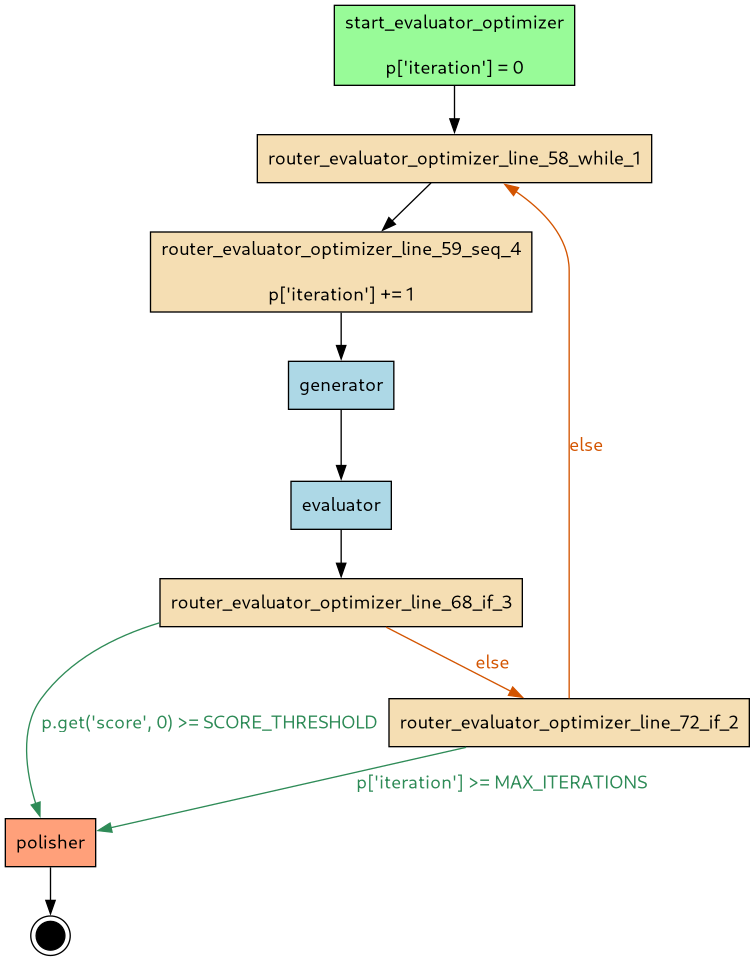
Each box is an independent actor. The loop runs as message-passing between queues.
More agentic flow examples: human-in-the-loop, orchestrator-workers, multi-agent debate.
Further reading#
- Agentic Patterns guide — routing patterns, tool use, multi-turn agents
- Streaming guide — FLY event protocol and SSE integration
- Pause/Resume guide — checkpoint and restore workflow